What Are You Looking For?
Follow Us On:


Salt spray testing is specifically designed to verify the corrosion resistance and performance stability of rubber wires, LED solder joints, metal connectors, and other components under salt-laden coastal environments. For decorative lighting in coastal cities and island resorts, buyers often worry about brightness and waterproofing. But the part that fails first is almost always the wire — the outer jacket hardens, cracks, and loses its flexibility, exposing internal conductors to salt air and rapid oxidation, eventually taking down the entire string. The LEDs may still light up, but the wire is already done. In coastal installations, wire material determines how long decorative lights will last.
Why PVC Wire Doesn't Work
Many decorative lights use PVC wire to keep costs down. PVC is cheap and easy to process, but it has a fatal weakness: poor salt spray resistance. In high-salt coastal environments, PVC wire gradually hardens, loses flexibility, develops micro-cracks on the surface, and eventually cracks and peels. According to salt spray test data for cable sheathing materials, PVC's corrosion resistance in salt spray environments typically lasts only 240–480 hours. In a standard coastal project, light strings with PVC wire may start showing signs of hardening and cracking within months — and soon require full replacement.
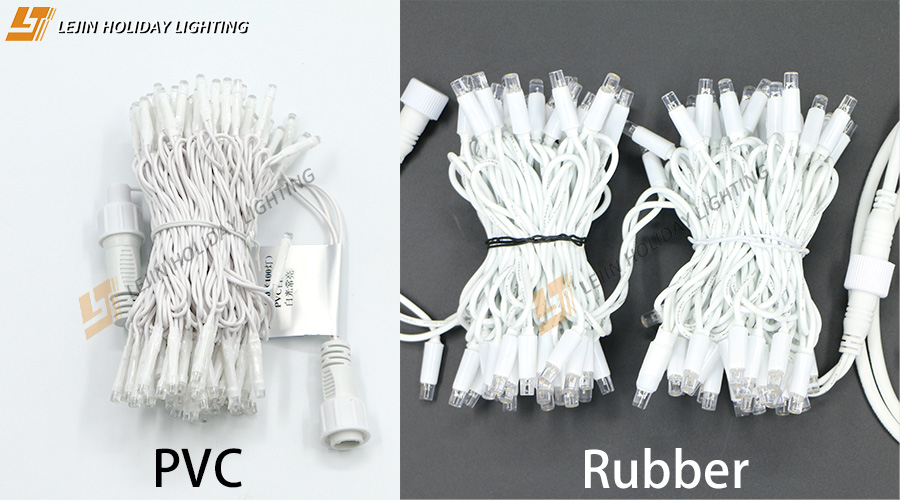
Why Blended Rubber Wire Isn't Good Enough Either
Some manufacturers blend other materials into the rubber to cut costs, calling it "rubber wire" when it's actually a mixed-material compound. These wires look and feel like rubber, but the problem shows up in salt spray environments. Different materials have different thermal expansion coefficients, making them prone to delamination and separation under temperature changes. Chloride ions penetrate more easily through the interfaces between materials. In simple terms, blended wire will develop internal delamination cracks over time, and its lifespan falls far short of pure rubber wire.
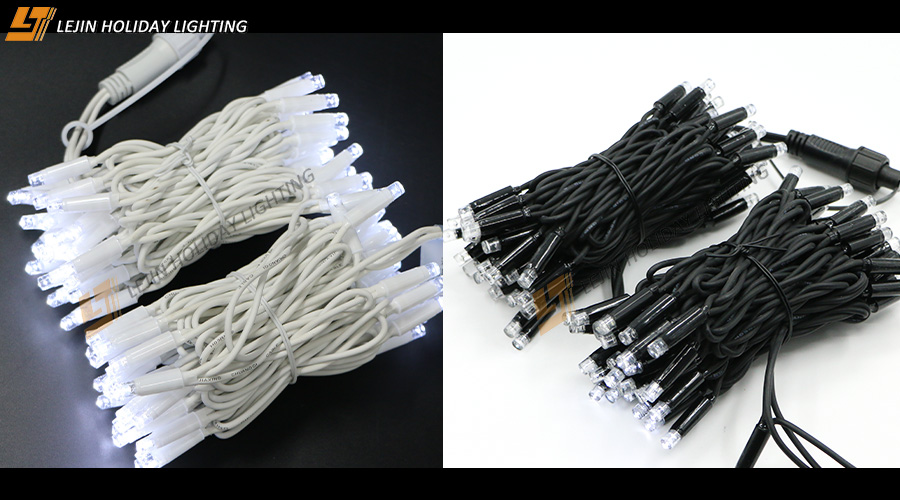
The Advantage of 100% Pure Rubber Wire
Pure rubber wire can withstand long-term salt spray attack. 100% pure rubber wire has a uniform composition with high density, making it difficult for chloride ions to penetrate. In coastal environments, pure rubber wire maintains its flexibility and integrity — it won't harden, crack, or peel. LEJIN insists on using 100% pure rubber wire, without blending any other materials to reduce costs. Verified by salt spray testing, LEJIN's rubber light strings remain in excellent condition even after extended use in coastal environments, with the outer jacket staying intact — this is the wire that coastal projects should choose.
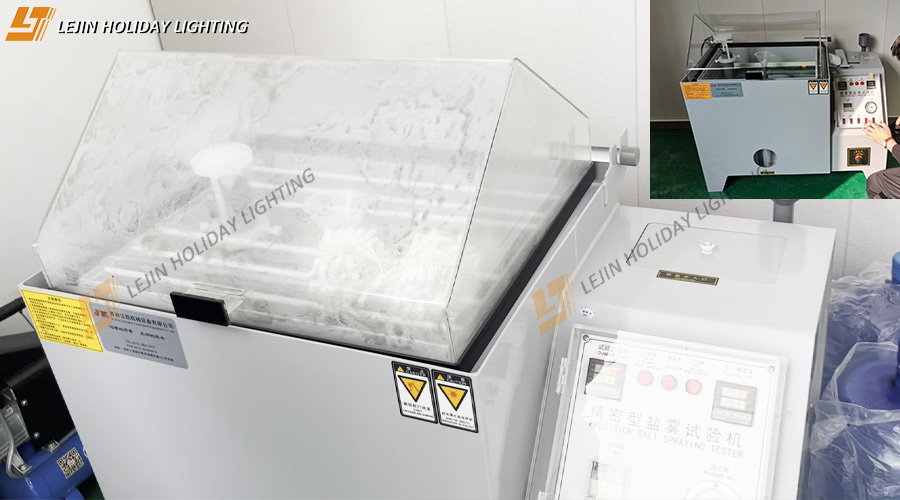
The biggest hidden cost of installing themed ornamental lights along the coast isn't the lights themselves, but the repeated labor and downtime caused by wire aging and replacement. PVC wire can't withstand salt spray. Blended rubber wire won't last. Only 100% pure rubber wire is the right choice for coastal projects. LEJIN guarantees that every batch of rubber light strings uses 100% pure rubber wire and has passed salt spray testing before shipment. If you'd like to learn more about LEJIN's test data or are selecting lights for a coastal project, feel free to contact us.



 IPv6 network supported