Themed Ornamental Lights

Home

Themed Ornamental Lights

  • Coastal Project Lighting Guide: How to Choose the Right Wire for Durability?
    Coastal Project Lighting Guide: How to Choose the Right Wire for Durability?
    Jul 15, 2026
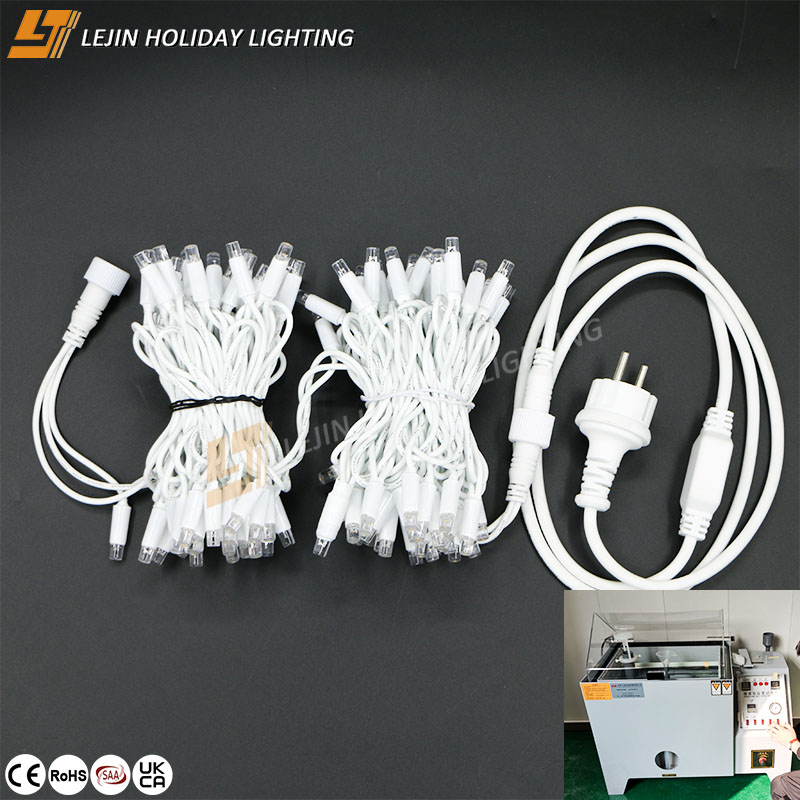
        Salt spray testing is specifically designed to verify the corrosion resistance and performance stability of rubber wires, LED solder joints, metal connectors, and other components under salt-laden coastal environments. For decorative lighting in coastal cities and island resorts, buyers often worry about brightness and waterproofing. But the part that fails first is almost always the wire — the outer jacket hardens, cracks, and loses its flexibility, exposing internal conductors to salt air and rapid oxidation, eventually taking down the entire string. The LEDs may still light up, but the wire is already done. In coastal installations, wire material determines how long decorative lights will last.   Why PVC Wire Doesn't Work Many decorative lights use PVC wire to keep costs down. PVC is cheap and easy to process, but it has a fatal weakness: poor salt spray resistance. In high-salt coastal environments, PVC wire gradually hardens, loses flexibility, develops micro-cracks on the surface, and eventually cracks and peels. According to salt spray test data for cable sheathing materials, PVC's corrosion resistance in salt spray environments typically lasts only 240–480 hours. In a standard coastal project, light strings with PVC wire may start showing signs of hardening and cracking within months — and soon require full replacement.     Why Blended Rubber Wire Isn't Good Enough Either Some manufacturers blend other materials into the rubber to cut costs, calling it "rubber wire" when it's actually a mixed-material compound. These wires look and feel like rubber, but the problem shows up in salt spray environments. Different materials have different thermal expansion coefficients, making them prone to delamination and separation under temperature changes. Chloride ions penetrate more easily through the interfaces between materials. In simple terms, blended wire will develop internal delamination cracks over time, and its lifespan falls far short of pure rubber wire.     The Advantage of 100% Pure Rubber Wire Pure rubber wire can withstand long-term salt spray attack. 100% pure rubber wire has a uniform composition with high density, making it difficult for chloride ions to penetrate. In coastal environments, pure rubber wire maintains its flexibility and integrity — it won't harden, crack, or peel. LEJIN insists on using 100% pure rubber wire, without blending any other materials to reduce costs. Verified by salt spray testing, LEJIN's rubber light strings remain in excellent condition even after extended use in coastal environments, with the outer jacket staying intact — this is the wire that coastal projects should choose.   The biggest hidden cost of installing themed ornamental lights along the coast isn't the lights themselves, but the repeated labor and downtime caused by wire aging and replacement. PVC wire can't withstand salt spray. Blended rubber wire won't last. Only 100% pure rubber wire is the right choice for coastal projects. LEJIN guarantees that every batch of rubber light strings uses 100% pure rubber wire and has passed salt spray testing before shipment. If you'd like to learn more about LEJIN's test data or are selecting lights for a coastal project, feel free to contact us.
    Read More

  • One Set of Smart Lights, Multiple Dynamic Effects
    One Set of Smart Lights, Multiple Dynamic Effects
    Jul 08, 2026
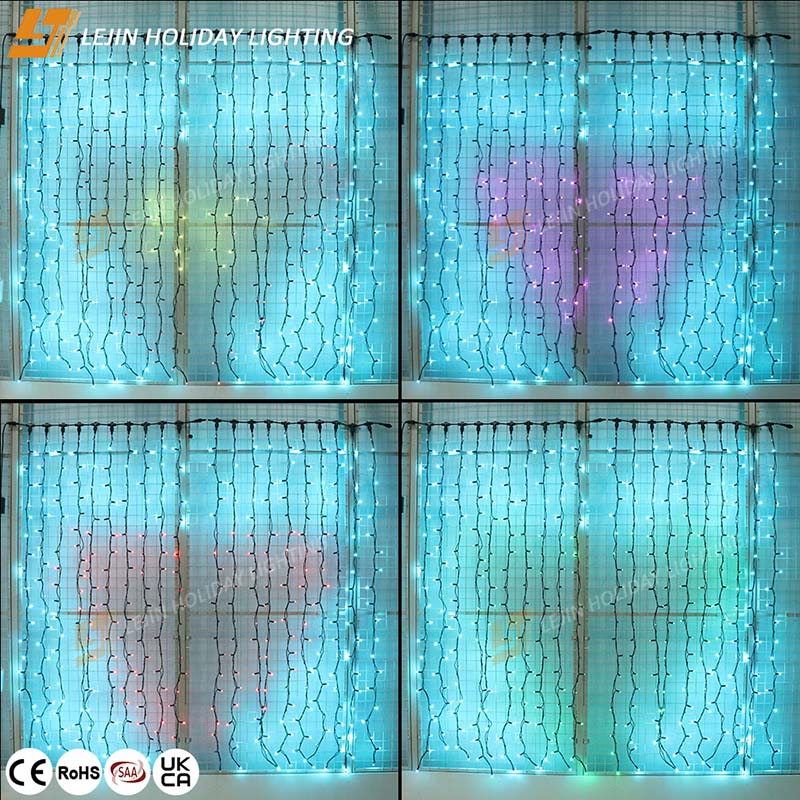
        The nighttime atmosphere of a commercial space depends largely on how its lighting performs. Static lighting only illuminates. Dynamic lighting brings the space to life — flowing, chasing, animation — each effect conveys a different mood. More and more commercial projects now require lights that "move," not just stay on constantly. LEJIN smart decorative lights offer rich dynamic effects through pre-programming before shipment, with one product meeting the visual needs of different scenarios.   More Than Just "On" — They Can "Move" The core value of smart decorative lights lies in achieving effects like flowing, chasing, and animation — not just simple on/off control. By programming the sequence and brightness changes of LEDs, the light can flow along a path like water, chase like a running horse, or present animated pattern transitions. This dynamic capability upgrades lighting from "background decoration" to "visual focal point" — customers' eyes follow the flow, and their mood is lifted by chasing effects. The same light strings, by switching between different effects, can give a space completely different character at different times of the day.     From Daily to Festive — Seamless Lighting Transitions Commercial streets have dynamic lighting needs. On regular evenings, a gentle flowing effect allows light to move slowly along the street, creating a relaxed walking atmosphere — customers browse comfortably and naturally extend their stay. On weekends or during promotional events, switching to chasing or animation effects picks up the pace and matches the energy of commercial activities. During the holiday season, exclusive animation effects like falling snow or twinkling stars can be custom-embedded without any hardware changes.     From Effect to Execution — Full Support Throughout LEJIN's R&D team pre‑programs effects like flowing, chasing, and animation directly into the product before shipment, based on project requirements. On‑site, clients simply select the most suitable effect from the preset options — no programming, no extra equipment, no on‑site debugging. We also support custom animation effects and text display — whether it's a brand logo animated across the lights or a holiday greeting scrolling through the display, all can be embedded into the light string's control program before delivery. From effect selection to on‑site installation, the LEJIN team provides one‑on‑one support throughout the process, so clients don't have to figure things out on their own.     Lighting is about more than turning on — it's about what a space says after dark. One set of smart lights shifts moods across different moments: relaxed weeknights, lively weekends, festive holidays — all with the same hardware. LEJIN smart lights come with effects pre‑programmed before shipment, ready for one‑click selection on‑site. From matching the right plan to final installation, we provide one‑on‑one support to ensure every light fits your space exactly. Looking for a lighting solution that "moves" for your space? Contact us for a custom effect design.
    Read More
  • Smooth Clearance, On‑Time Acceptance
    Smooth Clearance, On‑Time Acceptance
    Jul 03, 2026
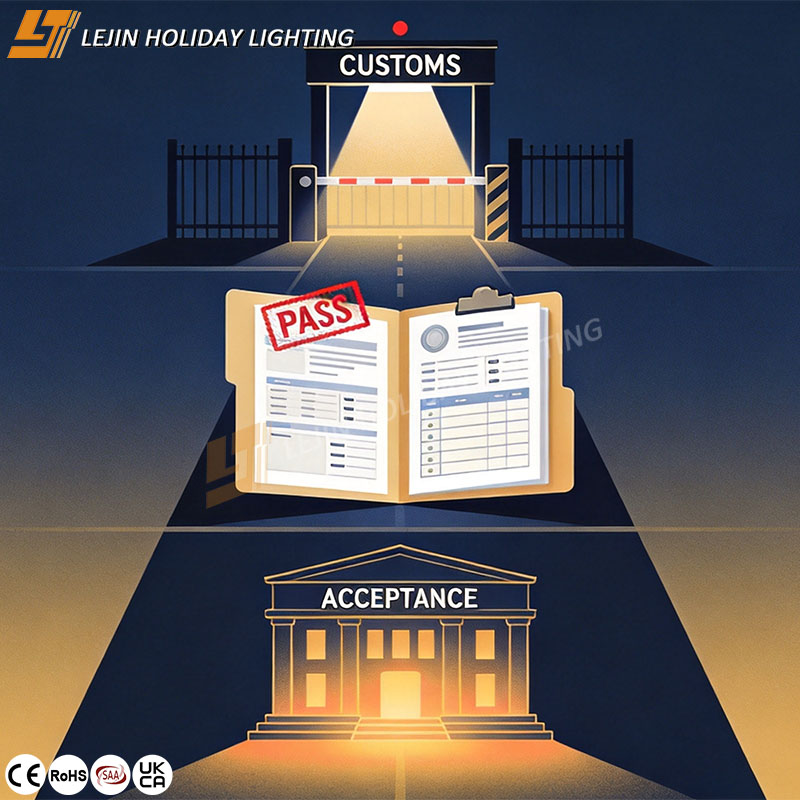
    Two things worry overseas project buyers the most. First: the container arrives at the destination port but gets held up by customs due to non‑compliant certification. Second: the lights are installed, but the client pulls out the reports during acceptance inspection and flags environmental failures or missing safety documents. Both share one common trait: by the time the problem surfaces, it's already too late to fix. LEJIN has been exporting festival lights for 26 years, and we know this better than anyone: the real value of certification is getting clients through customs and acceptance without holdups.   Customs Clearance – What Customs Actually Looks For Many buyers think clearance means "handing over a certificate." In reality, customs verifies whether this specific shipment matches that certificate. Different batches of the same model can fall out of compliance if material sources or production processes change. When your container arrives at the destination port, LEJIN can provide test records and compliance documents that directly correspond to that specific batch. This helps the local agent or buyer complete customs declaration quickly, avoiding delays caused by incomplete paperwork or mismatches between decorative lighting and certificates.     Project Acceptance – What Clients Actually Check Acceptance inspection goes far beyond turning the string lights on. Clients will check: Is the environmental report from this exact batch? Are electrical safety test records available? Are all compliance documents currently valid? One missing piece and acceptance gets stalled. LEJIN keeps a complete testing archive for every batch — from incoming material inspection to all relevant test records. Every compliance document required for market access is fully traceable. Whatever the client asks for during acceptance, we can produce it.     LEJIN's Certifications Cover Multiple Target Markets LEJIN's certification system extends beyond Europe and the UK. CE applies to the EU, UKCA to the UK, and RoHS serves as a common environmental entry requirement across many markets. On top of these, we also hold SAA certification for the Australian market, PSE certification for Japan, and applicable credentials for other countries and regions. No matter which region your project is located in, LEJIN can provide the compliance documents needed for that market's access requirements — preventing holdups at the door due to missing certification.     A single holiday lighting string certificate might get you through one random customs check, but it won't cover every batch or every project. LEJIN's certification system supports smooth customs clearance and hassle‑free project acceptance. That's why our clients rarely run into trouble at either stage. If you're facing clearance or acceptance issues, or want to learn more about LEJIN's specific certifications for your market, feel free to reach out to us anytime.
    Read More
  • Why Do Decorative Lights Fail Within a Week of Installation?
    Why Do Decorative Lights Fail Within a Week of Installation?
    Jun 26, 2026
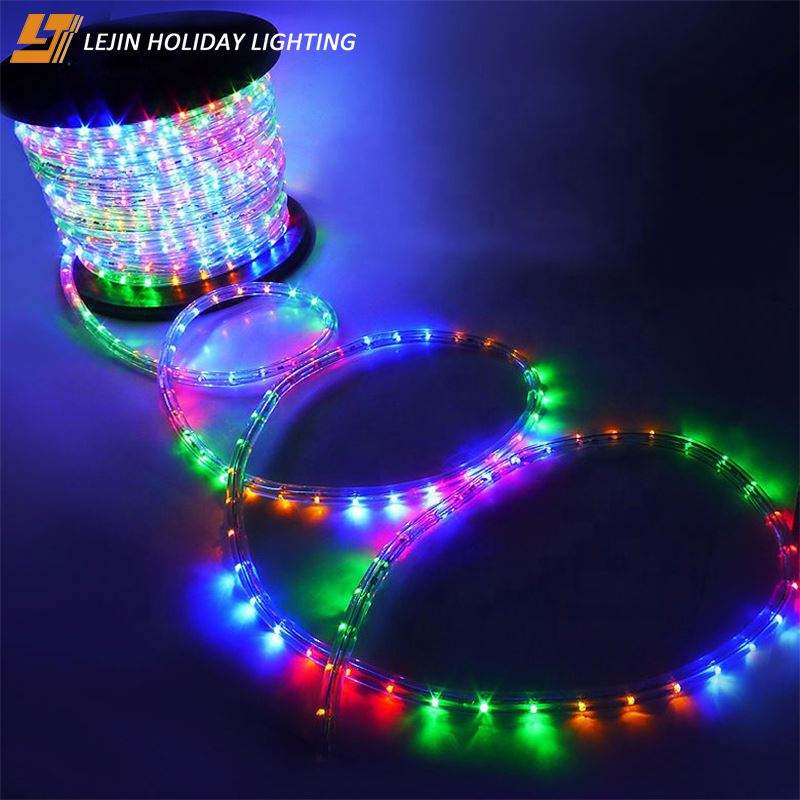
        Many clients have experienced this: decorative lights work fine during initial testing upon arrival, but a few days after installation, individual LEDs start to fail. A string with several dead LEDs ruins the entire display. The problem lies in the fact that a light that "turns on" initially doesn't necessarily mean it's durable. Some LEDs work at first but suffer from weak soldering or unstable chips, and problems only surface after hours of operation. True quality isn't revealed by a quick power-on test; it requires running the lights for an extended period. Every batch of LEJIN's decorative lights undergoes thorough aging testing before shipment, catching issues at the factory.     What Is Aging Testing? The logic behind aging testing is straightforward: power on finished light strings continuously for a set period, simulating actual usage, so that unstable LEDs, cold solder joints, and loose connectors expose themselves before the product ever leaves the factory. An LED with a weak solder joint might hold up for a few hours, but after dozens of hours, thermal expansion and contraction will reveal the flaw. Aging testing catches problems while the product is still in the factory. A problem discovered at the factory is a quality cost; a problem discovered at the client's site becomes compensation and reputational damage.     Where Do Dead LEDs Come From? Dead LEDs typically stem from three main causes. The first is unstable LED rope light chips themselves — poor-quality chips may dim or fail entirely within days. The second is soldering quality — cold or weak solder joints may conduct initially, but as temperature fluctuates over time, contact resistance increases until the circuit breaks entirely. The third is material mismatch — incompatible parameters between wires, resistors, drivers, and LEDs cause excessive heat buildup and accelerated aging during long-term operation. These three categories share one thing in common: none of them can be detected without extended power-on testing.     How LEJIN Conducts Aging Testing LEJIN follows a complete set of standards for aging testing. Every batch undergoes continuous power-on aging for a sufficient duration — no shortcuts, no compression of the timeline, no skipping of the process. Testing conditions simulate actual operating voltage and environment. Throughout the aging process, multiple inspections are conducted at scheduled intervals. Workers check each string individually, monitor brightness levels, identify any dead LEDs, and detect abnormal heat buildup. If any issues arise during aging, the entire batch is flagged and sent for root cause analysis. Units that fail are never shipped. Different products and specifications have different requirements, but the principle is always the same: thorough, sufficient, and never skipped.     Clients buying holiday decorative lights need more than just lights that turn on when installed — they need lights that stay on over time. LEJIN's aging testing is about stopping problems before they leave the factory. A dead LED caught at the factory is just the cost of one LED. The same failure discovered at the client's site means labor to dismantle and reinstall, project delays, and damaged trust. LEJIN commits to sending every batch of decorative lights through thorough aging testing before shipment.
    Read More

leave a message

leave a message
If you are interested in our products and want to know more details,please leave a message here,we will reply you as soon as we can.
submit

home

products

WhatsApp

contact