Outdoor Decorative Lights Easy to Fail? LEJIN's 5 Rigorous Environmental Tests — Withstanding Any Weather
Jun 16, 2026
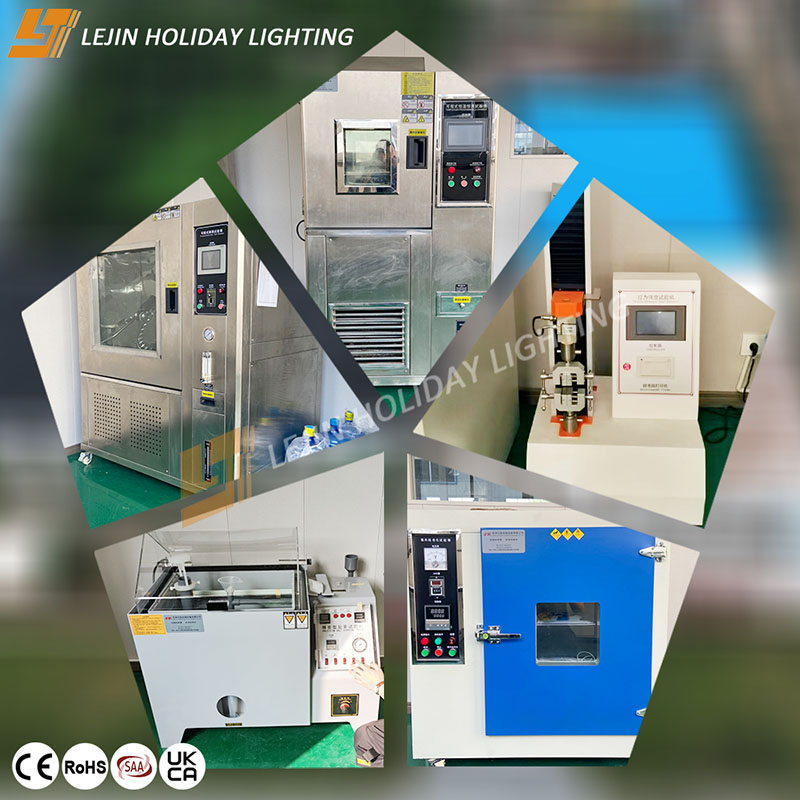
Many customers only care about whether decorative lights turn on. But what really determines their performance is whether they stay on — and for how long — under different conditions. Outdoor decorative lights face real challenges: summer heat, winter freezing, heavy rain, coastal salt spray, and long-term UV exposure. Before leaving our factory, every LEJIN decorative light product goes through five tests: High & Low Temperature Test, Rain Test, Salt Spray Test, UV Aging Test, and Pull Test.
1. High and Low Temperature Test
We place light strings in a temperature chamber and operate them continuously at temperatures ranging from -40°C to 70°C to check their performance under extreme heat and cold. Summer ground temperatures can exceed 40°C — decorative light strings hang outdoors from morning to night. In northern regions, winter temperatures drop to -20°C or lower — wires become stiff, solder joints become brittle. Through this test, we ensure decorative lights work properly whether they're shipped to tropical or freezing regions — starting up reliably, maintaining stable brightness, with no material deformation or cracking. No "heat stroke," no "freeze-up."
2. Rain Test
Outdoor festival lights face rainy seasons, typhoons, and humid weather. We spray products with water according to IP44 and above waterproof standards, simulating different angles and intensities of rainfall. String lights, connectors, and controllers — water intrusion anywhere can cause short circuits, electrical leakage, or complete failure of the entire festival light string. Through the rain test, we ensure festival light strings stay on during heavy rain — connectors stay dry, controllers stay safe.
3. Salt Spray Test
Coastal cities, beach resorts, and harbor commercial areas have high salt content in the air. Ordinary metals rust within days. We place decorative festival lights in a salt spray chamber for hours or days to observe corrosion on metal parts, solder joints, and screws. Rusted screws mean decorative lights fall. Rusted solder joints mean decorative lights fail. Through the salt spray test, we ensure decorative light products don't rust quickly in coastal environments — installed once, they stay put, able to withstand sea breezes.
4. UV Aging Test
Outdoor decorative lights are exposed to sunlight for years. Wires, housings, and lenses slowly age — yellowing, becoming brittle, even cracking. We use a UV aging chamber to simulate long-term sun exposure, accelerating the aging process to check material performance changes. Yellowing is a cosmetic issue. Cracking leads to water ingress and failure. Through the UV aging test, we ensure decorative light products remain in good condition after years of outdoor use.
5. Pull Test
This is a test many customers don't think about — but it's one of the most common pain points during actual installation. Workers pull wires when hanging string lights and drag strings during setup — these actions create tension on the connections between wires, plugs, and sockets. If solder joints are weak or crimps are loose, wires can pull out, leading to poor contact or lights not working. In worse cases, it can cause short circuits, overheating, and safety hazards. We use professional pull testing equipment to apply standard-specified tension to power cords and connection points — ensuring every wire is properly soldered, securely crimped, and able to withstand pulling force.
LEJIN decorative lights must pass these tests before shipment: temperature, waterproofing, corrosion resistance, UV aging, and pull strength. Each test is not a formality. It's a real quality threshold. We don't promise "never fails." But we promise this: every batch of decorative lights that leaves our factory has gone through these tests.
Read More






 IPv6 network supported